

Budget Spreadsheet Templates: The Complete Guide to Taking Control of Your Money in 30 Minutes
You know you should be budgeting. You’ve downloaded three different budgeting apps, started (and abandoned) two Excel spreadsheets, and once tried tracking expenses in a notebook that you lost after four days. Every financial expert says budgeting is essential, yet somehow your money disappears each month with little to show for where it went.
The problem isn’t your discipline or financial knowledge—it’s that most budgeting systems are either too complex (requiring hourly expense logging) or too simplistic (generic categories that don’t match your actual life). You need something that takes 30 minutes to set up and 10 minutes weekly to maintain, while actually showing you where your money goes and helping you make better decisions.
According to a U.S. Bank study, only 41% of Americans use a budget, despite overwhelming evidence that budgeting significantly improves financial outcomes. Those who budget are more likely to save consistently, avoid debt, reach financial goals, and feel less stress about money. The barrier isn’t desire—it’s finding a system that actually works for real life.
This comprehensive guide reveals how to create and maintain effective budget spreadsheets for any situation: individuals managing solo finances, families coordinating household expenses, couples merging financial lives, businesses tracking cash flow, and students navigating limited income. You’ll learn the essential components every budget needs, customization strategies for different life situations, and the maintenance habits that make budgeting effortless rather than exhausting.
Why Most Budget Attempts Fail (And How Spreadsheets Fix It)
Understanding why budgeting fails helps you build systems that succeed.
The Over-Complexity Trap
Many budgeting systems demand perfection: log every $2.50 coffee, categorize every transaction immediately, reconcile daily. This works for approximately three days before becoming overwhelming. Life happens—you travel, get busy, or simply forget—and the entire system collapses.
Spreadsheet solution: Build forgiveness into your budget. Weekly reconciliation instead of daily tracking. Broad categories instead of hyper-specific ones. A “miscellaneous” category for the stuff that defies categorization. Your budget should accommodate real human behavior, not require robotic consistency.
The Generic Category Problem
Default budgeting categories (“Food,” “Entertainment,” “Shopping”) don’t reflect how real people actually spend money. Your spending patterns are unique—maybe you spend heavily on professional development but nothing on entertainment, or allocate significantly to pet care that generic budgets don’t account for.
Spreadsheet solution: Customizable categories matching your actual life. If you spend $200 monthly on yoga classes and meditation apps, create a “Wellness” category. If you’re paying off student loans aggressively, create a “Debt Elimination” category that gets priority visibility. Your budget should reflect your values and reality, not someone else’s assumptions.
The Motivation Gap
Tracking expenses feels like homework—tedious, unrewarding, and disconnected from goals. When budgeting is purely restrictive (“you can’t spend this”), it’s abandoned quickly.
Spreadsheet solution: Goal visibility built into your budget. See your progress toward the vacation fund, emergency savings, or debt freedom every time you open the spreadsheet. Connect daily decisions to meaningful outcomes: “Skipping this $40 meal out means I’m $40 closer to my $3,000 vacation goal.”
The Essential Components of Every Effective Budget Spreadsheet
Regardless of your situation, effective budgets share core elements.
Component 1: Income Tracking
What to include:
- All income sources: Salary, freelance income, side hustles, investment returns, gifts
- Expected vs. actual: Planned income compared to what actually arrived
- Frequency: Monthly, weekly, bi-weekly, irregular (freelance)
- After-tax amounts: What actually hits your account, not gross income
Why it matters: You can’t allocate money you don’t have. Accurate income tracking prevents the common mistake of budgeting gross income while spending net income—a recipe for perpetual shortfalls.
Component 2: Fixed Expenses
What to include:
- Rent/mortgage
- Insurance (health, auto, home, life)
- Loan payments (student, auto, personal)
- Subscriptions (utilities, internet, streaming services, software)
- Childcare or dependent care
- Minimum debt payments
Why it matters: Fixed expenses represent your financial baseline—the amount you must cover before any discretionary spending. Understanding this number is critical for financial stability.
Component 3: Variable Expenses
What to include:
- Groceries
- Transportation (gas, public transit, ride-shares)
- Dining out and takeout
- Entertainment
- Clothing
- Personal care
- Household items
- Gifts
- Medical expenses (copays, prescriptions)
Why it matters: Variable expenses are where most people lose financial control. These categories feel small individually but accumulate significantly. Tracking reveals patterns you don’t otherwise see.
Component 4: Savings & Goals
What to include:
- Emergency fund contributions
- Retirement savings
- Specific goal savings (vacation, home down payment, car replacement)
- Investment contributions
- Extra debt payments beyond minimums
Why it matters: “Saving what’s left” results in saving nothing. Treating savings as a budget category—an expense you pay yourself—ensures progress toward financial goals.
Component 5: Budget vs. Actual Comparison
What to include:
- Budgeted amount for each category
- Actual spending in each category
- Variance (over/under budget)
- Running totals
- Month-over-month comparisons
Why it matters: The budget isn’t the goal—it’s the baseline for comparison. Variance tracking shows where you’re succeeding, where you’re consistently over budget (requiring adjustment), and where you have money to reallocate.
Budget Spreadsheet Customization by Life Situation
Different situations require different budget structures.
Individual Budget: Solo Financial Management
Unique considerations:
- Single income stream (or multiple if freelancing)
- Complete control over all financial decisions
- Building financial foundation independently
- Balancing current lifestyle with future goals
Customization priorities:
- Clear goal visibility: Emergency fund progress, debt payoff timeline, savings milestones
- Lifestyle allocation: Realistic amounts for social activities, hobbies, personal development
- Flexibility categories: Discretionary spending that adjusts based on income fluctuations
- Growth tracking: Month-over-month net worth progression
Key success metric: Consistent savings rate of 15-20% of after-tax income while maintaining quality of life.
Family Budget: Household Expense Coordination
Unique considerations:
- Multiple income sources (potentially)
- Dependent expenses (children, elderly parents)
- Longer planning horizons (education savings, life insurance)
- Coordination between partners
Customization priorities:
- Per-person allowances: Individual discretionary spending allocations to prevent conflict
- Child-specific categories: School expenses, activities, clothing, medical
- Household categories: Family entertainment, groceries, home maintenance
- Future planning: 529 accounts, life insurance, estate planning costs
Key success metric: Covering all household needs while saving 10-15% toward family goals (emergency fund, education, retirement).
Couple Budget: Merged Financial Lives
Unique considerations:
- Combining potentially different financial habits and values
- Determining shared vs. individual expense responsibility
- Balancing financial goals between partners
- Communication and transparency requirements
Customization priorities:
- Contribution structure: Equal contributions, proportional to income, or hybrid approach
- Shared expense categories: Rent, groceries, utilities, date nights
- Individual allowances: Personal discretionary spending with no questions asked
- Goal tracking: Both shared goals (home purchase) and individual goals (student loan payoff)
Key success metric: Both partners feeling financial decisions are fair, transparent, and aligned with shared values.
Business Budget: Cash Flow Management
Unique considerations:
- Irregular income (especially for new businesses)
- Business expenses separate from personal finances
- Tax obligations (quarterly estimated payments)
- Growth investment vs. profit distribution
Customization priorities:
- Revenue tracking: Multiple income streams, seasonal variations, client concentration
- Expense categories: Operating expenses, equipment, marketing, professional services, software
- Profitability metrics: Gross profit, net profit, profit margins
- Cash reserves: Operating capital for slow periods, emergency business fund
Key success metric: Consistent profitability with 3-6 months operating expenses in cash reserves.
Student Budget: Limited Income Management
Unique considerations:
- Limited, often irregular income (part-time work, financial aid, family support)
- Education-specific expenses (tuition, books, supplies)
- Minimal fixed costs but tight overall budget
- Building financial habits for post-graduation life
Customization priorities:
- Income sources: Work-study, part-time jobs, scholarships, family contributions, loan disbursements
- Education expenses: Tuition, fees, textbooks, supplies, course materials
- Minimal living costs: Shared housing, economical food, free/low-cost entertainment
- Debt awareness: Tracking loan balances, understanding future repayment obligations
Key success metric: Covering expenses without accumulating unnecessary debt while building financial awareness.
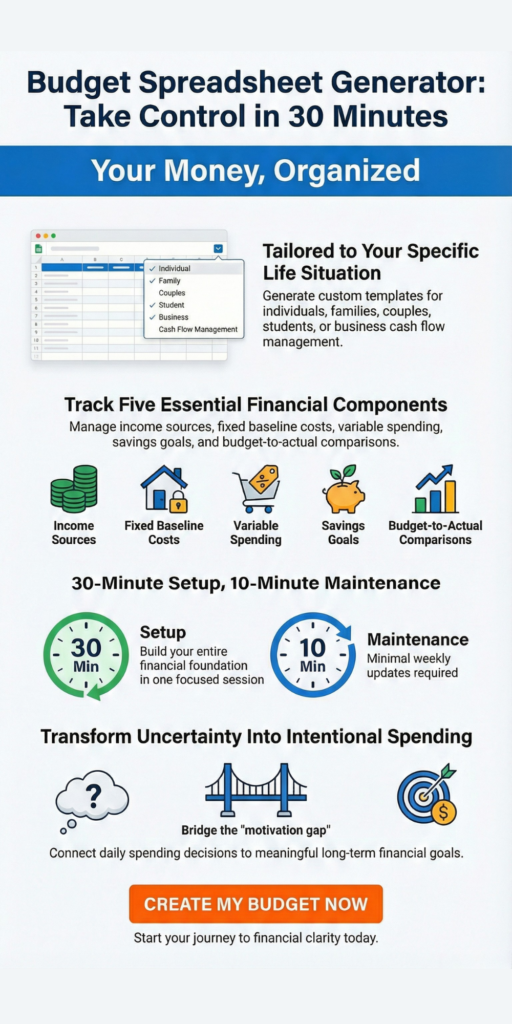
The 30-Minute Budget Setup Process
Creating an effective budget spreadsheet requires one focused session.
Step 1: Gather financial information (10 minutes)
- Last three months bank statements
- Credit card statements
- Pay stubs showing actual take-home income
- Fixed bill amounts (rent, insurance, subscriptions)
- Loan balances and minimum payments
Step 2: Calculate baseline numbers (10 minutes)
- Average monthly take-home income
- Total fixed expenses
- Average spending in major variable categories (groceries, transportation, dining)
- Current savings rate
- Total monthly expenses
Step 3: Build your spreadsheet structure (10 minutes)
- Income section with all sources
- Fixed expense categories with amounts
- Variable expense categories with estimated amounts
- Savings and goal categories with targets
- Budget vs. actual columns for tracking
- Summary section showing total income, expenses, and surplus/deficit
The Weekly Budget Maintenance Habit
Budgets fail when abandoned. Success requires minimal ongoing maintenance.
Weekly Review Process (10 minutes):
- Input the week’s transactions: Review bank/credit card activity, categorize transactions, enter amounts in actual spending columns
- Check category status: Identify categories approaching budget limits, note categories with significant surplus
- Make micro-adjustments: If you’re over budget on groceries but under on entertainment, consciously shift behavior for the remaining weeks
- Review progress toward goals: Check savings balances, debt payoff progress, goal achievement timelines
Monthly Review Process (30 minutes):
- Reconcile all accounts: Ensure every transaction is categorized and accounted for
- Analyze variances: Identify categories consistently over or under budget
- Adjust budget allocations: Increase allocations for consistently over-budget categories, redistribute surplus from under-budget categories
- Celebrate progress: Acknowledge debt paid down, savings accumulated, goals achieved
- Set next month’s targets: Adjust budget based on upcoming irregular expenses (insurance payment, holiday spending, travel)
Common Budgeting Mistakes and Solutions
Mistake 1: Forgetting irregular expenses Your car insurance might be $600 annually, paid every six months. Forgetting to budget $50 monthly means facing a $300 bill with no preparation.
Solution: List all irregular expenses (annual insurance, holiday gifts, car registration, Amazon Prime subscription), calculate monthly allocation needed, include as budget category.
Mistake 2: Unrealistic category allocations Budgeting $200 for groceries when you’ve spent $400 monthly for three years doesn’t create discipline—it creates a budget you ignore because it’s disconnected from reality.
Solution: Start with actual historical spending as baseline. Reduce gradually (10-15% maximum) if genuinely motivated to cut spending. Dramatic cuts fail.
Mistake 3: No buffer category Life brings unexpected expenses—prescriptions, car repairs, gifts for events you forgot. Without budget flexibility, these derail everything.
Solution: Include a “miscellaneous/buffer” category of 5-10% of your budget for the unpredictable expenses that are actually very predictable.
Mistake 4: Treating the budget as restrictive Budgeting isn’t about what you can’t spend—it’s about intentionally allocating money toward what matters most to you.
Solution: Reframe budgeting as “spending plan” aligned with values. Money spent on priorities (including entertainment, hobbies, nice meals) isn’t “bad”—it’s intentional.
Transform Your Financial Life in 30 Minutes
Financial stress stems largely from financial uncertainty—not knowing where money goes, whether you can afford things, or if you’re making progress toward goals. A simple budget spreadsheet eliminates that uncertainty.
The investment is minimal: 30 minutes to set up, 10 minutes weekly to maintain. The return is enormous: clear visibility into your financial life, intentional spending aligned with values, consistent progress toward goals, and significantly reduced money stress.
Key principles for budgeting success:
✅ Start simple – Basic categories and weekly tracking, add complexity only if needed
✅ Customize ruthlessly – Your budget should reflect your life, not generic assumptions
✅ Track consistently – Weekly 10-minute reviews prevent the system from collapsing
✅ Adjust frequently – Budget allocations should evolve as spending patterns become clear
✅ Focus on trends – One overspending month isn’t failure; three consecutive months signals needed adjustment
✅ Connect to goals – Link daily spending decisions to meaningful financial objectives
Ready to take control of your finances? Our Budget Spreadsheet Generator creates customized budget templates for any situation—individual, family, couple, business, or student budgets. Choose your scenario, input your specific income and expense categories, and generate a fully structured spreadsheet ready to populate with your numbers.
Stop wondering where your money goes. Generate your custom budget spreadsheet now and build the financial clarity and control you’ve been missing.
Additional Resources
Personal Finance Communities:
- r/personalfinance on Reddit – Active community with wiki and guidance
- r/ynab – You Need A Budget methodology discussions
- Bogleheads Forum – Investment and personal finance guidance
Budgeting Education:
- Khan Academy: Personal Finance – Free financial literacy courses
- MyMoney.gov – Federal financial literacy resources
- Consumer Financial Protection Bureau – Financial tools and information
Financial Tools:
- Mint – Automated expense tracking
- Personal Capital – Investment and net worth tracking
- EveryDollar – Zero-based budgeting app